Monday, July 19, 2010

Curren$y - Pilot Talk (Album Review)


Pilot Talk's cover art features a series of fighter jets swooping over a massive landscape filled with marijuana leaves. This is unabashed hip-pot. In a lot of ways, Curren$y and his music is a lot like what Meth & Red were in the 90's, albeit with a lot less personality and skill. Even so. This is an album by a hip-hop loving weed smoker, for hip-hop loving weed smokers.

Topics on Pilot Talk range from that magical-and-peculiar-smelling-substance to girls (bitches) to money to being dope. There's a grand total of one-half tracks that feature something different (all thanks to a murderous guest spot from Jay Electronica). They say that if it ain't broke, don't fix it; how about if it ain't broke, don't fix it, but don't use it thirteen consecutive times. My point here is that Curren$y needs some new shit to talk about, as Pilot Talk's monotonous subject matter gets old after a while.

The primary factor preventing Pilot Talk from being ultimately trash is the man with the boom-bap: Ski Beatz. Responsible for production on every track save two, Ski lays down some superb groundwork for Curren$y to rhyme about one of his four subjects. The beats are cohesive and part-of-a-whole, but with each creating it's own identity. Hats off for that, as the lyrics frequently do little to distinguish one track from the next. The instrumentals steal the show more than once, most notably on the knocking "Audio Dope" and ridiculously smooth "Roasted." The beats are so dope on these cuts that they manage to lift the lyrics on top of them to a higher tier.

Sure, Curren$y rhymes across a depressingly unoriginal and short spectrum of topics, but there's a reason he stays in his comfort zone: he's good there. The first track gives an example of both his confidence and abilities on the mic:

Reimburse me for paid dues

The money made me move, running through my shoes

For the day that I can kick em off, relax

I said I'd quit smoking these beats but I relapsed


There are plenty of moments like this on the LP, where we see the skills that Spitta has, and the potential for excellence he holds. It's just that it's hard for anything to leave a lasting mark in the strict musical template he's locked himself into.


Another saving grace for Pilot Talk is a series of well-timed guest spots. Just when Spitta's repetitive material is getting to be too much, the features are ushered in, and everybody performs well. Smoke DZA, Young Roddy and Stalley all come through and do their thing, offering nice changes of pace. The best guest spot goes, unsurprisingly, to Jay Electronica, who shits on everybody's life, as he tends to do.


Ultimately, Pilot Talk is a good album. Just good. It has moments that are much better than good, and vice versa. It's worth a couple of listens for those good parts, but in it's entirety it only asks for one or two plays.


Grade: 7.5/10

Sunday, July 18, 2010

The Best Producers-Emcees

Recently, a lot of really dope rappers have been stepping behind the boards to flex their producing muscles. Many have smoothly made the transition, and are now forces to be reckoned with on and off the mic (Andre 3000, Inspectah Deck, and Ill Bill to name a few). I don't want to talk about them, though. This little diatribe is all about some of the most talented people who've been producing their whole career, with some only picking up the mic in the past couple of years. These are my four favorites, in no real orders.

First up, MF Doom.
On the production tip, he's been making dope shit for years, from his KMD days to now. Most of his beats heavily feature samples from old cartoons, as well as clapping ass drums. The combination is hard to dislike. On the mic, Doom has always been a polarizing figure. But, when you look at it, he's rapping about what most rappers do, he's just saying it in a different way: there are songs where he's basically talking about nothing (besides being dope); songs about ladies, some where they're the love of his life, some where they have cheated, and some where they're just smuts; stories; and more. People disagree, making the claim that Doom's talking nonsense - they're wrong. Even if they deny his content, it's hard to deny his technical skill. Doom's verses are filled with complex rhyme schemes that weave in and out of a buttery flow, all delivered in Doom's murky voice. He's one of the game's best producer-emcees, equally gifted on both spectrums, and deserves all the acclaim he gets and more.

We go to Detroit for the next prodcee (what a terrible word I've just invented), Black Milk.
He's made a shitload of dope beats over the years, contenting himself as one of the game's premier beatmakers for a couple of years before debuting his first LP, Popular Demand. Every Black Milk beat I've ever heard is dope - no joke. Literally every one. Granted, I haven't heard all of them, but I've heard a lot, and the fact that I haven't been forced to deal with any wackness yet is saying something. On the mic, some of his early stuff is a bit maladroit, but in recent years he has stepped his shit up. His next album, Tronic, shows this, and all signs point to his forthcoming Album of the Year continuing this progression. As long as he keeps going at or near this current level, he'll be one of the game's elite for years to come.

We come now to a pioneer of the game, and arguably (emphasis on arguably) the best producer of all-time: the RZA.
In the early 90's RZA helped revolutionize the game, with no small thanks due to his groundbreaking producing. The dark and grimy sound spread like wildfire along the East Coast, often imitated but rarely matched. You won't find many people denying that. As an emcee, RZA has always been a much more controversial man. His mushy cadence and delivery (the result of a speech impediment) are matched with what is often an inconsistent flow, which can make for some not-so-good rapping. That being said, when he's on his shit lyrically, it's hard to think of many people who can fuck with him. If we look at all the material in his oeuvre as a rapper, the dope certainly outweighs the wack. As a producer, he's Top 10. That combination is why he's here.

Coming straight out of the Delorean, the final prodcee on the list is El-P.
Everybody always calls his work dystopic and futuristic and all that shit, so if I were to call his music that I'd be bringing nothing new to the table. That being said, it's really hard to think of other words to describe his work besides maybe dope, which I use about 17 times a post. El Producto's beats have always been crazy, from the days of Company Flow and Cannibal Ox to now; over the years they've grown a bit more crisp and polished, but retain the same apocalyptic mood. On the mic, El-P is a divisive figure: some people love his nerdy, frequently arhythmic flow, with others despising him for the same reasons. For my money, his flow and sensibilites can get tiresome occasionally, but pound for pound he's able to craft some ill shit, and is a strong breath of fresh air in the congested rap world.

So that's my list. All of these dudes deserve more credit, as they all have considerable talents behind the boards and in front of the mic. By the way, Dr. Dre was excluded from this record because to be considered anything with "emcee" in the title you have to write your own shit.

Rhymefest - El Che (Album Review)

Sometimes, people make promises that they don't keep. It happens. Obama did it to the American people; this merchant did it to me when he told me if I gave him my cows he'd give me beans that'd grow into a gigantic ladder to a palace in the sky; I know I do it every time I tell a girl that sex with me is gonna be great. Rhymefest's second LP, the much-anticipated El Che, is an example of just such a promise.

The promise that El Che makes (and fails to deliver on) is that it's going to be a concept album. The cover and introduction (as well as the two other skits on the album) make the promise, offering an exciting and intriguing premise from the beginning. The cover shows Rhymefest with a drink, cigar, gun, beret, and two books: My Bondage and My Freedom by Frederick Douglass and Ralph Ellison's Invisible Man. This is enough to pique some interest, at the least. The intro-skit features Rhymefest ("Che") getting approached by two agents on a train and being forced to flee. He runs into the streets, sirens at his back, before launching into a revolutionary-minded freestyle. The track fades, and we move into the meat of the album.

From here, the concept is all but abandoned outside of the skits. The times when he touches on anything remotely revolutionary are some of the best points of the album: "Prosperity," a scathing critique of organized religion, "City Is Falling," a great dosage of hip-hop blues, and finally, "Give It To Me." The last of these three is the most interesting, largely because featured guest Saigon fairly easily out-Che's Rhymefest on his own shit. Saigon has always been at his best when rhyming consciously (see: "Color Purple," "The Corner," or "Pain In My Life"), and on this track he's on his revolutionary shit hardbody. Fest, on the other hand, seems a lot more goofy and playful in his verse, kind of deading his own steez. Notice how Saigon's verse ends and Rhymefest's begins:

Saigon: And that God look over me, plus you aqui

Cuz the cops is killing us and just get through scott-free

The system don't give a fuck, and I ain't tryna accept it

I gotta make sure all of me and mine is protected

So if I feel threatened I'm gonna get me a weapon


Rhymefest: While you tryna bang the chick with the mustache

I was hanging out with Tiger Woods when his truck crashed

'Dawg is that your wife? Aw shit nigga, duck fast!'


Kind of makes me wish that Saigon had come out with an album where he takes on the roll of Che, but given that I've been waiting on Sai-giddy's aptly-titled Greatest Story Never Told since I could walk, that's fairly unrealistic. Even so, Rhymefest's whole concept got crushed in one 16.


Despite the fact that Che rarely actually spits some revolutionary-minded shit (if Immortal Technique heard this CD he'd be pissed; but Immortal Technique is always pissed, so...), this is still an excellent collection of tracks. Taken alone, you'd think their combination would form into one of the best albums of the year. Actually, it does, although the lack of cohesion does detract from it's overall value.


Fest has several songs dedicated to haters and fakers in the biz, a few for the ladies, a story telling track, and a few optimistic cuts. Some of these are incredibly dope. "Say Wassup" (featuring Phonte) is some of the smoothest and dopest shit I've heard in a minute, perfect for L-smoking or just chilling or spending time with the squeeze. "One Hand Push Up" is catchy, inspiring, and laced with fiery verses. "Agony" is one hell of a reggae-meets-rap song; it's what Distant Relatives would've been if Marley and Nasir had taken a few less pretentious pills before writing. The song is all about the good agony about to be put on some girl, and if it wasn't for Saigon's 16 would be the best part of the LP.


"Chicago" is another superb track, and actually fits into the concept. Rhymefest basically calls out all the wack cats in the game without actually naming names. Observe how he does his thing over a spooky dark beat:


A whole lot of hipsters, internets, and kids now

Took your Mario mushrooms - oh your big now?

Well lemme show you bout things

Take your redbull so I can rip off your wings


Basically, this album is filled with some very dope tracks. As I said above, they don't exactly mesh together very well, and there's also a few missteps along the course of El Che.


The most apparent of these is the closer, "Celebration," which brings all of the LP's momentum to a halt and ends things on a very sour note. Another bit of weakness are the album's fourth and fifth tracks, "How High" and "Chocolates," respectively. The first (with some heavy-hitting guest features in the form of Little Brother) is a hackneyed "you can do it" song, while the second is Rhymefest using a Forest Gump sample to describe how hard it is for him to pick just one lady. This would be doe if Fest wasn't sleepwalking.


On the production tip, the beats are almost all on point. "Prosperity" features a desperation to its sounds that allows Rhymefest to spray his vitriol without remorse; "Last Night" is perfectly trippy and spaced-out for the trippy and spaced-out story told over it; "Give It To Me" is soulful and dope and (just so nobody can ever forget ever) ripped to shreds by the Yardfather.


El Che is far from a sophomore slump; in fact, it's undeniably a much better effort than his first LP, Blue Collar. It features a plethora of great tracks to appreciate, with Rhymefest's typical blend of humor, consciousness, and - dare I say it - swagger. The lack of cohesion and the fact that this album doesn't come close to fulfilling the promise it offers in it's beginning hinder it, but this is still one of 2010's strongest releases yet, and is highly recommended to any hip-hop head.


Grade: 9.25/10

Saturday, July 17, 2010

The Roots - How I Got Over (Album Review)


Lyrics reflect the thoughts and feelings of whoever is writing it. That's why Eminem's newest release was all about getting back to normal after being on drugs; why Kanye's is surely going to be all about Kanye being great; and why Gucci Mane's entire catalogue is built around stupidity. While listening to the Roots' newest album, How I Got Over, it's clear that Black Thought was looking out at the world we live in and wondering about his role in it.

How I Got Over seems almost to be some kind of very loose concept album, about somebody seeing the world for how shitty it is (and yes, it is shitty), getting over it, and preparing to grab the world by the horns. The first half is dark and ominous, while the second is optimistic and bursting with hope. Despite the antithetical moods, the shift from one to the other is far from jarring. All of the members of the Roots not named Black Thought are primarily the ones deserving credit for this, creating an album that is cohesive, filled with sounds that have similar characteristics throughout, but with (almost) every song establishing it's own identity: the first song is primarily comprised of somber pianos and some moody wind work; while the last heavily features an auto-tuned version of a baby's cry. And both are dope.

As excellent as the instrumental work is, the lyrics make it a whole, and the Roots have one of the best of all time - Black Thought - handling that end. The first half of How I Got Over features emcees surveying the world and seeing it for all it's worst qualitie. The first line of the LP, delivered by Truck North, captures the feeling and sentiment expressed throughout the first third of the album: "Trapped, no shield, no sword." Each track manages to expand on this feeling of being trapped without beating a dead horse, and while the different tracks are similar musically, they each have their own separate defining qualities. Lyrically, Black Thought sounds more than capable of matching the darkness. Although these opening tracks are filled with guest spots, Black still manages to stick out and be the main player on each track. His opening verse on "Dear God 2.0" is a shining example of why this is:

They said he's busy, hold the line please

Call me crazy, I thought maybe he could mind read

Who does the blind lead? Show me a sign please

If everything is made in China, are we Chinese?

And why do haters separate us like we siamese?

Technology turning the planet into zombies

Everybody all in everybody's dirty laundry

Acid rain, earthquakes, hurricane, tsunamis

Terrorists, crime sprees, assaults and robberies

Cops yelling "stop freeze", shoot him 'fore he try to leave

Air quality so foul, I gotta try to breathe

Endangered species, and we running out of trees

If I could hold the world in the palm of these

hands, I would probably do away with these anomalies

Everybody checking for the new award nominees

Wars and atrocities, look at all the poverty

Ignoring the prophecies, more beef than broccoli

Corporate monopoly, weak world economy

Stock market toppling, mad marijuana

OxyContin and Klonopin, everybody out of it


From here, things get more upbeat. "Now or Never" and the titular track signify the transition, and from here the songs feature much more light and inspirational lyrics. But not in a corny way. The end of Black's first verse on the excellent "The Fire," featuring John Legend, is a perfect example:

Something in my eyes say I'm so close
To having a prize
I realize I'm supposed to reach for the sky
Never let somebody try to tell you otherwise

The entire second half of the beat is home to similar lyrics, based more around accepting the fact that life's a bitch and then trying to treat her the right way.

The closing duo of tracks feature the strangest instrumentals and cockiest lyrics. They both feel completely natural where they are thanks to the gradual progression from one sound to the next, which allows such risks. Hearing these braggadocios rhymes serves to illustrate the completion of Black Thought's "getting over" the harshness of reality and coming to dominate it. Take, for example, this clip from "Web 20/20:"

Jawns keep telling me I'm great like Gatsby

Caught like a felony, you can't slide past me

I'm low-key, kind of anti-flashy

Then I'm OG up in a black tie classy

Sun Tzu to Sun Rai, Gargemel, Mumm-Ra

Son of a shooter letting slugs from a gun fly

Should call a Mumbai with the bumbaclot

It's Black Thought, my sound's hard to come by

Last spotted on a yacht getting dumb high

Banging yacht rock with my squad from 215

Straight calling niggas out like the umpire


It's clear that Black Thought is on his shit. That being said, it's not until the sixth track that he holds the mic down by himself. On How I Got Over, it feels as if the Roots are a group filled with as many emcees as otherwise, given the abundance of guest spots. As usual, Dice Raw is on a good bit of tracks, this time four. The welcome additions of Blu, Phonte, Truck North, STS and P.O.R.N. all get two verses to shine each, with Peedi Peedi getting one appearance. Besides emcees, there are appearances (for hook purposes) from the aforementioned John Legend, Patty Crash, and Joanna Newsom. Thankfully, all of these guests hit their respective pitch out of the park. The singers brought in go perfectly with their song, and manage to take it to a place that Black Thought and most other people with vocal chords couldn't. Every emcee knows what they're doing as well, and although none actually manage to steal a track away from Black, a few come very close (most notably P.O.R.N. on "Radio Daze"). Each guest spot adds to the feeling of belonging the LP holds, never detracting from a song or feeling out of place.


Ultimately, as the auto-tuned sobs of the infant (and the vicious bassline that accompanies it) ends, one is left with a very cohesive effort. There's only one skippable track - "Doin' It Again," which is repetitive and unrewarding sonically - with the rest of the album being filled with superb material. How I Got Over is a hip-hop head's wet dream, filled with both lyrics and beats that are instantly enjoyable but also contain a depth that take multiple listens to fully enjoy. This is, so far, the best release of 2010.


Grade: 9.75/10

Thursday, July 15, 2010

Reflection Eternal - Revolutions Per Minute (Album Review)

If you don't know who Talib Kweli and/or Hi-Tek are/is, you should just leave. If you do, you know how dope the combination's first album was. Revolutions Per Minute is their second collaboration.

They both sound very comfortable in their respective zones: on the mic, Kweli is as good as ever, and when he wants to he can murder a track; Tek knows what he's doing on the boards, and when he's on his shit he can hang tough with any producer in the game. This much is abundantly clear after the first three tracks (following the superfluous introduction), which give the impression that neither has missed a step since their classic first album. On the fourth track, "Strangers," Talib unleashes a rarely-heard anger, while still maintaing a Zen-like questioning of realities.

They tappin laptops like a bad plot out a bad movie, Obama say it ain't so

In a perfect world coalition of the willing is really coalition of the rainbow

Who the enemy? Who the friend in need?

How do you choose your target, who you aim for? What you aim for?


Most of the LP is filled with dope beats and dope rhymes. Reflection Eternal sounds like one of the illest producer-emcee combinations ever on tracks like "Back Again," "Got Work," and the weed-a-rific "Lifting Off." The last of which is one of the best tracks: hella smooth, with dope lyrics from Talib that manage to serve as both a cry to the people and an anthem to get real nice and zooted to.


The best track on Revolutions Per Minute is the one that looks like it'll be the best after reading it on the tracklisting: "Just Begun," featuring Mos Def, Jay Electronica, and J. Cole. This song is essentially shadowboxing from four of the most talented dudes in the game: two of which are already established legends, while the other two have huge followings with the internet heads (you probably like em if you're reading this) and are going down the same path to greatness that Def and Talib did way back when. For my money, Jay Elec took this one, but a case could be made for any verse.


Despite the many up's on the album, there's still a good amount of negatives. "In This World," is one, with Talib repeating most of the themes and messages that he's already conveyed in the past couple of tracks. This is a problem that permeates much of the lyrical content of Revolutions Per Minute, with Talib frequently beating a long-deceased horse as if he doesn't know it's dead. "In the Red" is another subpar track, this one the worst of the CD. It has good intentions to rhyme about music from several aspects - from fan to creator - but it feels disingenuous and bogged down by a weak instrumental.


Speaking of which, Tek's production here seems either very dope or very wack. More than once Talib has to save a track through some excellent lyricism, bailing out another weak beat. Even worse, these beats feel more like an assortment of instrumentals for some producer's sampler than a cohesive collection of sounds that an album's beats are supposed to have.


The combination of subpar production and frequently repetitive lyrics turns out to be a not so enjoyable one, unsurprisingly. There are occasional moments of brilliance and most of the tracks are very good, but this album is far from a classic. It's an enjoyable listen all in all, but certainly not something that sticks with the listener past its first rotation. All of this is a shame, especially considering some of the incredible stuff these two are capable of.


Grade: 8.75/10

Wednesday, July 14, 2010

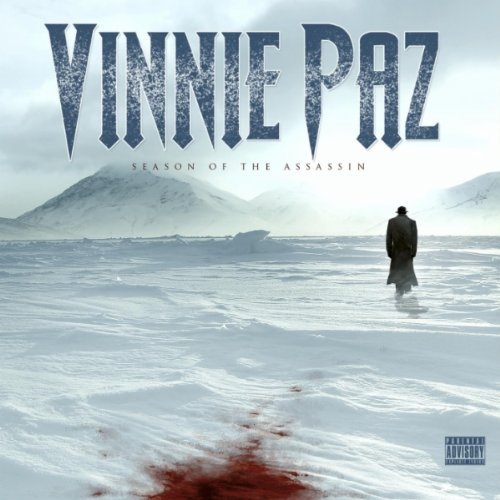
Vinnie Paz - Season of the Assassin (Album Review)


Vinnie Paz is a member of the seminal hardcore underground hip-hop group Jedi Mind Tricks. The lead singer, if you will; the group's soul emcee for all but two of their six albums. His lyrics are super aggressive, delivered in his trademark growl that frightens children and I. He frequently ends a line with one word over and over (usually "muhfucka" or something similar) and acts like this makes it rhyme. His content is extremely angry, usually about being a "real" Muslim (and calling those who aren't pussies or some variant thereof), killing people, and conspiracies/big-brother-is-watching. Also, raging homophobia. So much so that it's clear that Paz is either a complete idiot or a closet homosexual; they're both highly likely. That being said, Jedi Mind Tricks is an amazing amazing group. That's because of the producer end of the duo (sometimes trio), Stoupe. His epic and often-imitated (but never replicated) beats have carried Paz's extremely offensive and frequently subpar lyrics. This album is Paz's test as a rapper, as Stoupe doesn't make a single appearance. Paz will have to do it without dope beats.

Or not. Just because it isn't Stoupe on the boards doesn't mean it's me. Paz got his paws on some great producers on this one, and just about every beat bangs. It's definitely a different sound from JMT though; this one much more raw and street-oriented, where Stoupe's production often sounds like a hip-hop composition of an epic film.

For anyone unfamiliar with Paz's style, the opening lines of the LP pretty much illustrates the main thrust of his oeuvre:

I'm out for whatever you wanna call it - cash or paper
My only purpose to kill, perfect assassinator
I'm on the path of Islam, you on the path of Vader
My nickname buck-50 cousin, pass the razor
The 750 eye turn you from a fan to hater
Feeling myself, like I'm a chronic masturbator


The only thing missing from his style there is his signature homophobic rhymes, which are - thankfully - largely absent from the album. It certainly adds to the enjoyment, as some of the vocal fantasizing he would occasionally indulge himself in on previous works was both weird and unlistenable.

One of the standout tracks is "Role of Life," home to a murky Bronze Nazareth instrumental that is relatively new territory for Paz but turns out to be right in his sweet spot. His vocals compliment the beat perfectly, creating a grim and amazing cut. Lyrically, Paz doesn't go for consistently using the same rhyme seven or eight times in a row, going for more conventional (and effective) rhyme schemes that are reminiscent of his old style, with a few quotables to boot (You motherfuckers don't belong in rap/ fuck with me, you gotta better chance taking an abortion back; and I run with Puerto Rocs, morenos and vagabonds/ And Paz'll shoot this motherfucker up like Barry Bonds).

Paz sounds hungry, and the fairly consistent lyrical content becomes more and more bearable. At times it gets a bit old, but songs like the one above make the listener all but forget their displeasure.

Perhaps the most exciting track on Season of the Assassin is "Bad Day," which offers Paz going in a new direction without some of the oddly emo stuff that resulted from his previous similar attempts. "Bad Day" is Paz spitting a sort of day-in-the-life rap that is clearly exaggerated, but still relatable to the common man (especially if that common man is living a somewhat similar life that Paz is self-deprecatingly glorifying). The hook pretty much illustrates the rhymes perfectly:

Every time that I feel that shit is going my way
Something come along and fuck up my day
I had a rhyme in my mind, now there's nothing to say
And cousin that just fucked up my day
Driving down the block, someone cut in my way
That shit went and fucked up my day
Rap critics, they always got something to say
I would never let that fuck up my day


These are, I would say, the most easily relatable lyrics of Paz' career. Maybe it's the weed, but "Bad Day" feels like the definition of a hip-hop blues song.

Other songs that aren't about murder are "Keep Movin' On" and "Same Story (My Dedication)." As far as this style (non-murder) of Paz goes, these songs are also incredibly strong for him, probably the best of his career. "Keep Movin' On" is a story track about folks down-on-their luck, while "Same Story" is a personal story from Paz to his sick sibling. Neither of them achieves the emotion gained from other rappers telling similar stories (just last year Paz's fellow Army of the Pharaohs member Apathy did it better a few times on his album), but it's still better than his previous efforts. It is clear he is improving in this regard. That being said, these are two of the weakest tracks on the LP, for two reasons: one, they feel very out of place and serve to break up some of the ferocious momentum Paz built up in songs before it (this is especially true of "Same Story," the finale that follows the vicious and sneer-inducing "Drag You to Hell"), and; two, they both are fairly formulaic, with Stoupe knock-off beats that don't contain the same poignancy that the other's soulful instruments incur and a generic female singer belting out a hook.

Guests play a substantial role on the album, as is true with most JMT-related releases. On their best albums, supported is provided through excellent guest spots (or, in the case of Violent By Design, the old Jus Allah); on their worst, the supporting cast is substantially less talented (or, in the case of History of Violence, the new Jus Allah). Here, the guest spots are crazy dope. Familiar faces like R.A. the Rugged Man and Ill Bill (two of my favorite rappers ever) show up, as do (surprising) first-time collaborators like Freeway, Beanie Sigel, and Paul fucking Wall. Holy shit.

Ultimately, Season of the Assassin is a surprisingly high-quality record. This is definitely in the top handful of releases of the year, and might even by my favorite album released this year - time will have to determine that. It looks as if Paz can survive without Stoupe pretty easily, with an album twice as strong as the previous Jedi Mind Tricks LP, while Stoupe's solo effort last year was the weakest output of his career. What is going on? Have we been wrong all along?

Probably not. Either way, this is an excellent album, a must for anybody who won't be put off by the lyrical content. For fans of vintage Jedi Mind tricks, this album is a dream come true, and provides for one of the year's best LP's.

Grade: 9/10

Tuesday, July 13, 2010

Eminem - Recovery (Album Review)

Let me tell you about the first time I saw Anchorman. I thought it was terrible and couldn't make it past the forty-minute mark. But, since I had the DVD, I checked out the special features. Before long, I found myself laughing my ass off, and kept the disc around for a quick laugh the next time I was in the mood for one. The blooper reel and line-o-rama showcase the funny people in the movie, and illustrate the potential it had to be a hilarious film. But they still don't make Anchorman a good movie.


Eminem's new CD,
Recovery, is kind of like my Anchorman DVD.

The album's first sixteen tracks are like the film itself, with the three bonus tracks (only one of which being on the physical CD) taking the role of the extra features. Why on Earth they weren't included on the actual album is beyond me, especially considering some of the songs that did make the cut. Let's cover those which were included first.

From the beginning, one of the instantly noticeable problems with
Recovery is the production. This much is clear just from looking at the tracklisting and seeing that Dr. Dre only produces one of Recovery's songs. The beats range from atrocious to good (I wouldn't say that there's any "great" instrumentals), rarely bad enough to warrant a skip but rarely good enough to induce a head-nod.

To make this worse, Eminem sounds uncomfortable and out of place on just about every one of them, offering a plethora of weak concepts, played punchlines and artificial emotions. To sum up the lyrical content in one word, I'd probably use "forced." Or maybe "desperate." They're both true.

Marshall spends a lot of time trying to establish to his listeners that good ol' Slim Shady is back. He goes about this in a few ways. First, he brings out his trademark extremely played, unfunny and dated pop-culture references that are limited to one or two targets (Michael J Fox gets three or four lines dedicated to him over the course of the LP, with each line being essentially the same thing). Second, he shits on his last two CD's that everybody - himself included, I guess - hates. And, third, he announces that he's back about twelve times per song, constantly telling the listener he's the best and can't be touched on the mic (his words, not mine).

The problem with this is that he spends so much time telling us that he's back that he doesn't get a chance to be back. Also, he isn't really back. The lyrics here aren't half as good as they were on his last album that wasn't fucking awful, The Eminem Show. On the opener, "Cold Wind Blows," Em tells us that he'll "stick [his] dick in a circle, but [he's] not fucking around." That's not exactly at the same level as when he was "more toward dropping an accapella to chop a fella to mozarella worse than a helicopter propeller."

And these lyrics are only on the "I'm The Shit" tracks, which make up about 40 percent of
Recovery. The remaining 60 percent are devoted primarily to a mostly tedious combination of lifeless love songs, (mostly) trite inspirational tracks, and radio-ready pieces of shit. The love songs are the lesser of these three evils, but are still horrible. "Space Bound" is emo-rap at its worst, frequently sounding like it was written by a junior high-schooler. There's some trademark Em aggression thrown in there, but that's not enough to save such a dismal effort. The inspirational songs are considerably tougher to get through. The lead single "Not Afraid" defies you to listen to it in its entirety, while "Cinderella Man" and "Almost Famous" seem taken from the 8 Mile soundtrack's trash bin. Finally, the fucking atrocious songs appealing to the only people who will actually buy albums these days: teenage girls. "Won't Back Down" (with Pink), "Talkin' 2 Myself" (with Kobe), "No Love" (with Lil Wayne) and "Love the Way You Lie" (with Rihanna) all make a retired Eminem sound like a great idea. Notice how they all have guest spots? Guess what - they make the songs they're on worse. The worst of those four songs is probably "No Love," which features Just Blaze's worst beat in maybe forever, and equally bad verses from Weezy and Slim, with each one of them spending a verse churning out cheesy, forced punchlines in between a maddeningly shitty hook.

As usual with me, almost all of what I've said so far has been negative. There are certainly good parts to
Recovery. The third and sixth tracks, "On Fire" and "Going Through Changes," respectively, especially stand out. "On Fire" is produced by D-12 groupmate Mr. Porter, and is the only time on the LP that Em actually lives up to all that "I'm back" bullshit he talks. The lyrics are dark and witty, and Eminem sounds hungry and vicious here. (Unlike in other similar attempts, during which Em seems to confuse lyrical ferocity and intensity with simply screaming.) "Going Through Changes" reveals what he was going for with the majority of the songs on Recovery. While the beat isn't as infectious here as it is on "On Fire," it still gets the job done, allowing room for Eminem to air out some personal stuff. This song basically takes 80% of Relapse and puts it into one song, with Em talking about the before, during, and after of his battle against addiction. The hook is wack as fuck, but other than that it's a dope song.

All in all,
Recovery is a disappointing effort from Eminem, but everything he's put out has - to some extent - been a disappointment for the past decade, so it's no big deal. Better luck next time, Slim.

So that's the movie. Credits roll on "You're Never Over," which lives up to it's title and makes four minutes feel like four days. Sheesh. Now it's time for the bonus materials.

The first, an untitled hidden track, is ferocious. Em does his thing over Havoc's sole beat on the LP, eclipsing the success he found with "On Fire." The beat here is a bit better suited to lyrical mayhem, and Eminem uses that to his full advantage. There are both good lines and bad ones, but the former definitely outweigh the latter, and this track is a lot of fun while being evil like the old Em.

The second is "Ridaz." This is Slim giving the people some dope fight-music. The listener is most likely to leave this track thinking that they're the fuckin man and can fight anybody, making it the only track on Recovery that succeeds in being inspiring. It is Dr. Dre's second beat on the LP, and proves once again that these two should work together as often as possible.

The final is "Session One," with Slaughterhouse. This is Just Blaze's only dope beat on the CD (let's pray he gave all his good instrumentals to Jay Elec), and everybody does their thing on it. Eminem definitely gets ate by all of Slaughterhouse, especially returning homebody Royce da 5'9" and Long Beach's own Crooked I. This song is a straight up barrage punches over a banging instrumental, with quotables in every verse.

Ultimately, these three tracks alone provide more enjoyment than the rest of
Recovery can. They all have replay value, whereas only two or three of the actual songs on the album have it. They serve to show a few things: first, that Em still has "it," he just needs to relearn how to consistently unleash it; second, what Recovery could have been; and finally, third, that it really is a bad album when held up to something good.


Grade: 5/10

Monday, July 12, 2010

Nas & Damian Marley - Distant Relatives (Album Review)

Nas is known for making what is arguably the best hip-hop album of all time; Damian Marley is known for being the son of the most well-known and arguably the best reggae artist of all time (Damian also made - again, arguably - the best reggae album of the 2000's). So, yes, expectations going into this project were arguably high.


High. That is what you're supposed to be anytime you are experiencing a product being presented by somebody with the last name of Marley. Not that I'd ever do that, I'm just saying.


Anyway, Distant Relatives is dope. The chemistry between Marley and Nas is undeniable, made apparent from the first couple of seconds of the opening track "As We Enter." Here, Marley and Nas trade bars back and forth over a head-nodding instrumental, offering the only song of the album that doesn't contain any social or political message. The meshing of their two styles and sensibilities is on display here both lyrically and musically, and it's a wetdream for fans of either genre of music. Marley has an excellent voice, and can both belt out a chorus or spit a verse with a sing-songy flow; Nas is one of the best emcees of all time, and knows how to handle himself on any beat thrown his way. The combination of traditional reggae and boom-bap Eastcoast hip-hop collide to give the listener the best of both worlds. The style errs towards the reggae end of the spectrum, but Nas's lyrics and demeanor easily strike a balance.


It wouldn't be a stretch to say that four or five of the songs on Distant Relatives will find their way to Nas's or Damian's Greatest Hits CD someday. That's saying something considering the two of them have fourteen albums between them. Those songs are what we in the industry like to prematurely call "instant classics." It's impossible to call an album with four or five of these "instant classics" a bad album, but is Distant Relatives itself one?


No. Sometimes, the production really takes away from the overall enjoyment I can derive from a song, no matter how fantastic the vocals and lyrics are. The CD's third track, "Strong Will Continue," is one such case. Marley and Nas sing and rap their respective balls off, but the beat feels kinda like something from a mildly successful Japanese RPG from the early 2000's. Not only is that a very specific sound, it's a very bad one. Another example is "Count Your Blessings," where the beat seems to come from the music they play inside supermarkets. Not a good look.


Still, those are maybe the only two skippable tracks on the LP, with the other songs being best described as either very good or great. This is definitely one of the standout releases of the year, and while it isn't in the top tier of records put out in 2010, it's certainly a lot better than some of the stuff put out this year, and should deservedly make many year-end lists when the time comes. Buy this if you like the sounds associated with either one of these guys; you won't be disappointed.


Grade: 8.5/10

Welcome

This is where I'm going to post my reviews and shit.